
Vol 1. Leadership Lessons from Community Organizing
Leadership Lessons from Community Organizing
I got my start in social change work as a grassroots organizer for environmental campaigns.
It's hard to overstate the impact that learning to organize had on my career trajectory and the way I've shown up to every role since.
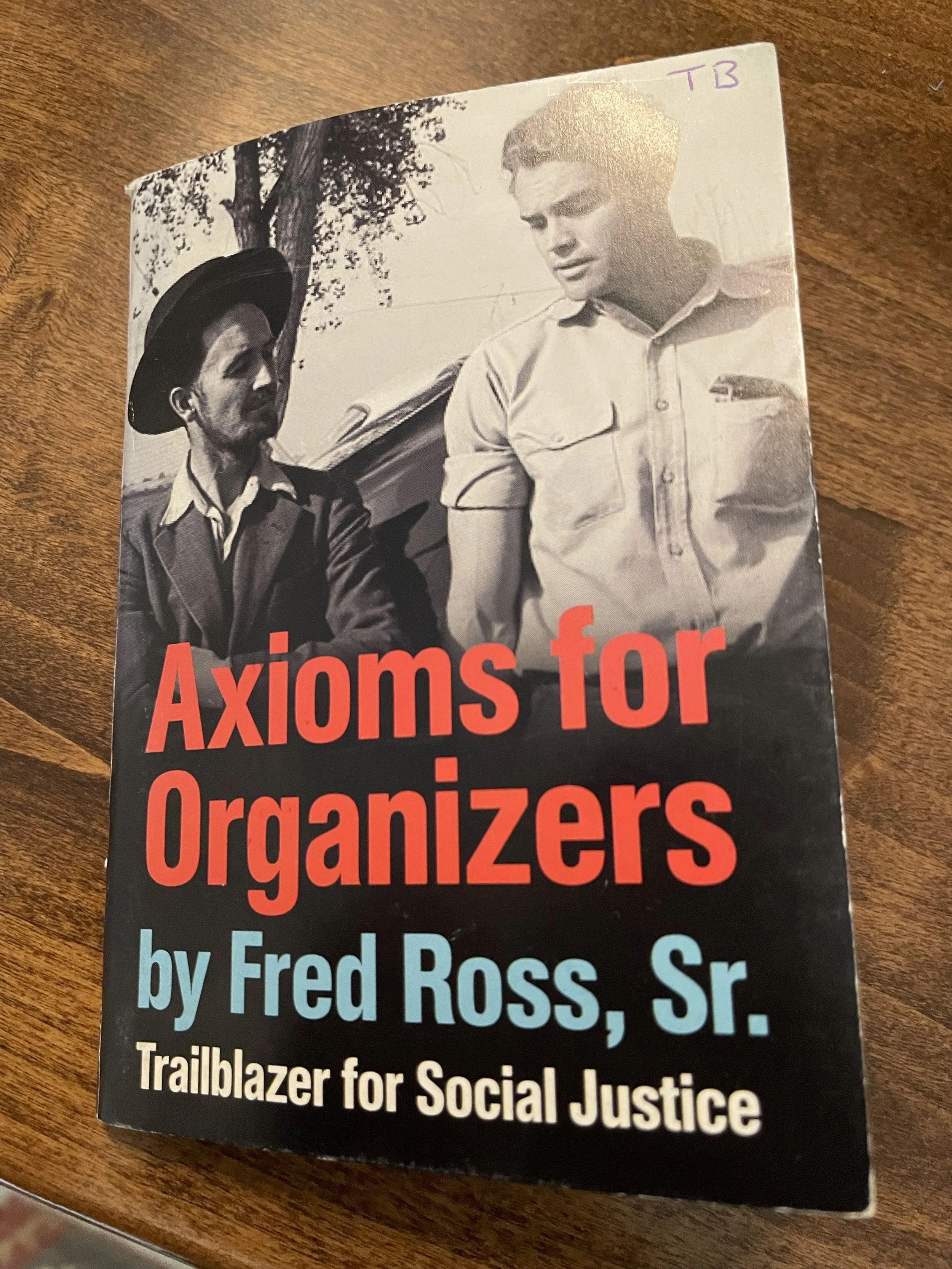
Last year, as I reflected on the contribution I want to make through this work, my organizing history came further into focus. I wanted to find my old copy of Axioms for Organizers by Fred Ross Sr. We used to distribute them to all staff and board members at my old organization. My copy had been lost in a move, but my old boss, friend, and organizer-to-the-core, Patti Lynn, saved the day by sending me her extra copy.
As I've deepened my coaching practice, I find myself sharing organizing lessons with new manager clients frequently. The principles that shaped how I learned to build power and develop leaders in community campaigns apply directly to the challenges managers face in mission-driven organizations today.
This year, I'm taking time to tease this out through a newsletter series: Leadership Lessons from Axioms for Organizers.
Here's the first installment.
Organizing Is
"Organizing is providing people with an opportunity to become aware of their own capabilities and potential." — Fred Ross Sr.
I could interchange organizing, leadership, and managing in this quote and it would still capture the essence of my philosophy on leadership development.
If a manager is committed to leadership development, they own that it is their responsibility to hold a vision for their team member's potential that may live beyond that team member's own current imagination.
It’s definitely not about imposing that vision. It’s about inviting them into seeing it for themselves.
This requires creating conditions where someone can step into their own capabilities, not just meet your expectations of them.
It can be challenging to navigate the balance between providing guidance and vision and supporting autonomy. We want our team members to define and pursue their own growth and vision for themselves. But sometimes circumstances, experience, and fear can limit someone’s ability to dream big for themselves.
So what does this look like in practice? Imagine your new team member is a solid task-master– they complete their assignments well and on time and they are great at following your direction. But you see they have the capacity to develop the plan and vision for their work. They are ready to start providing their own direction, and you recognize their potential to deepen their strategic thinking and eventually lead projects from start to finish.
How do you support them? Answer questions with questions. Provide coaching that helps them arrive at answers for themselves. Get into the habit of having them run through their plans for the project before they ask you for guidance. And perhaps most important? Tell them about the shift you’re making in how you respond to them. Share your vision for their growth and let them know that this is one way you’ll support them through it.
When we've been individual contributors ourselves, this transition can be challenging. But facilitating a shift from executor to leader is perhaps the most meaningful transformation a manager can support.
When you create these conditions for someone to discover their own capabilities, one of two things happens.One, they might realize a part of themselves that was lying dormant and unexpressed. Or, they might receive permission to become more of who they really are and allow their capacity to expand in a direction that’s more genuine, independent of your vision. Both paths are powerful.
In my own path, I’ve been deeply impacted by the mentors and managers that invited me to see my own potential. Sometimes it was as simple as giving me ownership of a project that felt slightly beyond my current capabilities and experience. Other times, it was encouraging me to follow a career path that felt terrifyingly new or unknown. But each time, they provided a vision, supported me along the way, and sometimes held a mirror to the best part of myself that I may not have been capable of seeing at the moment.
I see this organizing principle as being at the heart of authentic and supportive leadership development. It's about removing barriers that prevent people from seeing and stepping into who they already are. It’s about offering an invitation, and making space for them to take the next step. When we approach leadership development in this way, we don't just build capacity in individual team members, but we contribute to conditions that allow for ongoing, regenerative development across our organizations.
Over the coming months, I'll be exploring how other organizing principles map onto the leadership challenges we're navigating today.
I’d love to hear what you think of this first installment: When has someone held a vision for your potential that you couldn't yet see? How did they invite you into that awareness?
If this perspective on leadership development resonates, please share it with a friend!
Services Spotlight
I recently partnered with a small organization to build a simple, values-aligned competency model that clarified what skills are essential at every level of the organization.
Managers had been asking for more transparency around advancement, and leaders wanted a tool that made expectations clear without adding unnecessary complexity. I spent time getting to know the organization: its roles, expectations at each level, and the unique context in which staff demonstrate their skills. From there, I built a clear framework that defined how behavioral competencies show up differently across positions.
We created something they can now use for skills-based performance management, hiring, and leadership development systems.
This is one way I love supporting organizations as they strengthen their leadership development pathways.
If you’re thinking about embarking on a project like this in 2026, I’d love to connect.
There is a direct throughline from my organizing experience to the leadership development work I do today. I’m excited to continue exploring that link through this series.
I'm grateful to have you along for this exploration. If these reflections are valuable to you, please consider sharing them with a friend who might benefit. And if you’d like to continue the conversation, you can always reply to this email. I read every response.
Best wishes for a healthy, joyful, and purpose-driven new year.
Warmly,
Michaela
If you’d like to continue receiving this series by email, subscribe here.